
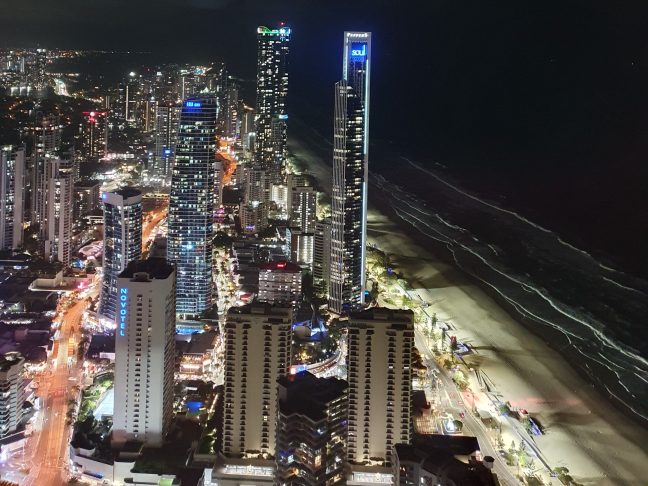
The ‘Surfers Paradise Tall Stories – Loud in the City’ series asks why city life is so loud and how we can change it. This is the fifth article in the series looking at how ubiquitous fossil-fuel driven equipment has become in high-density high rise cities, and why it needn’t be so for much longer. By unraveling the complex tangle of noise in this small city of tall buildings, and finding out what could be done differently, perhaps we can find ways for residents of high density living everywhere to get fresh air and a better night’s sleep.
Not too hot, not too cold, it’s just right
The climate at the Gold Coast must be the planet’s most liveable. Not too hot, not too cold, it’s just right; the type of climate where you can leave the windows open almost all year round. No wonder so many people moved here during the Covid19 pandemic. Open windows mean breathable air free of air-borne molecules of virus!
But maddeningly, the noisy soundscape of urban Surfers Paradise’s external environment often compromises residents’ access to fresh air. I don’t subscribe to locking myself away from the oceanic air but at night, close the windows and shut the doors tight I do. I’m sure many of my neighbours do too to save their sanity. The downside in the tropical part of the year is that avoiding the noise and bright lights traps heat.
I use energy-efficient ceiling fans at night when my doors are closed but most people in search of some semblance of a good night’s sleep go straight to air conditioning for climate ‘control’, though this is seldom the same as ‘climate comfort’. Unlike the actual climate, air-conditioned spaces are frequently too cold, too dry, not cool enough, too still, or blowing too stiff an arctic blast. They can be eerily soundless, or humming relentlessly, but are guaranteed to make indoor conditions feel weirdly disconnected from the sensory ups and downs of real life.
The cost of a good night’s sleep
In the high-rise modern city if you want thermal comfort and not to be woken by the noise outside, choice is limited. Some apartments are sealed by necessity (to block unwanted city noise) and air-conditioned by choice; others are hermetically-sealed by design and air-conditioned by necessity.
There are many reasons why apartment living design that depends on air conditioning (AC) for comfort is not ideal. Trapping and sharing harmful virus molecules can be a problem for starters. Closed air-conditioned buildings can also be prone to condensation, leading to mould and unhealthy air quality.
Power bills add up: unlike their ground-based neighbours who can run air-con from their roof top solar power, affordable renewable energy is not really a thing for most occupants of multi-storey apartment buildings in Queensland. Hopefully the forthcoming Solar Sharer Offer of three hours of free power during the day for households with smart meters will apply to strata residents too.
AC fails in a power blackout. It’s no coincidence that power outages occur during the kind of weather when it is needed most — stormy, hot and steamy.
Built-in product obsolescence of AC hardware is another downside. Aided by the salt-laden coastal atmosphere, balcony-mounted condensers are likely to need replacing even earlier than their intended use-by date. When they’re working, condenser fans and motors add their bit to the city’s ambient roar.
I don’t use air conditioning in my apartment, don’t intend to and don’t need to. (Ask me again in 2035; I’ve got a feeling this ‘Goldilocks’ climate might not last!). The building I’ve chosen to live in was designed in the early 1970s. Its structural approach to climatic design suits the climate better than any old ‘could-be-anywhere’ design with mechanical compensation for climate benefits foregone.
Passive design – active occupants
Where I live, passive climatic design credentials keep us cool by day and comfortable by night naturally. Credentials like the building’s solar orientation, form and layout for air flow, strategic window sizes and placement, and materials (solid concrete walls and glass windows and doors in a balanced ratio versus fully glass walls). The projecting balconies and deep overhangs shade the glass and as an expected bonus, these integral features preserve visual and acoustic privacy between adjacent apartments above and below as well. Everything works together. We added the ceiling fans but other heating or cooling systems are not part of the base building.
We’re attuned to the changing weather conditions over a day and over a year. We actively attend to trimming the apartment’s metaphorical sails according to when we want to invite the sun or wind in and when to keep them out. We’re mindful of the quotidian weather and we interact with the building, closing and opening windows and doors, and lowering and raising blinds depending on the the direction and strength of the wind, and the angle of the sun. We wear cooler or warmer clothing when we need to. Life is never monotonous.
Night cooling
In principle, the building’s architecture enables the critical strategy of ‘night cooling’. This means that when the air temperature drops a bit in the subtropical summer night, one can throw open the windows and doors and flush out all the overheated air accumulated during the day.
Also, because our apartment’s internal concrete walls, floor and ceiling are not covered in layers of plasterboard or carpet, their thermal mass is put to good use. At night, as they slowly release the heat absorbed from the surrounding air during the day, this too is flushed out, especially when helped by ceiling fans. The flushing process cools the dwelling overnight, ready for the next day. The design of the external openings are the keys to success of the strategy. Cross-ventilation is a must-have and is achieved by purposeful location and sizing of windows and external doors. Unless fresh air can be pulled in through a high small opening on the windward side and drawn out through a larger opposing opening, taking the heat out with it, heat has nowhere to go except back into the apartment, where it will stay day after ghastly hot humid day.
Unfortunately most residents wouldn’t dream of trying night ‘flushing’ these days. While it’s impossible to sleep with blinds up due to the bright lights of other city buildings, and with balcony doors open due to late night noise, I try to encourage hot air to escape naturally in the evenings and cool early mornings.
All view and no feels
Contemporary apartment building design all but ignores the spectacular climate and focusses instead on the spectacular view. Taller and taller towers provide less and less connection to the place’s phenomenally good climatic characteristics. At greater and greater heights, the subtropical wind makes outdoor living and cross-ventilation impossible. Residents can merely view the environment through tinted glass walls. As well as the thermally monotonous air-conditioned indoor climate, free of the sound, taste or feel of the oceanic city, apartment living at great heights must be like dwelling behind permanent sunglasses. The artificial climate inside could be anywhere else but the most liveable place on the planet.
When we fall back on the kinds of buildings that depend on late 20th Century design and 19th Century technology that has made fossil-fuel driven equipment essential for the operation of the buildings we live in and the cities we inhabit, we are locked into a positive feedback loop that produces the kind of noise we’d do anything to avoid for a good night’s sleep.
Instead of taller and taller energy-dependent towering giants being the only answer to the question of how we house the population in a high-density setting, shouldn’t we be looking at alternative architectural paradigms that allow connection with nature and connection with other people? If we invest in more creative, more humane approaches to high density living design, we can save our sanity and reduce CO2 at the same time. We would reduce the external noise instead of reducing our connection with the ebb and flow of the seasons, the days and the nights.
 subtropicalcities.com