The ‘Surfers Paradise Tall Stories – Loud in the City’ series of articles asks why city life is so loud and how we can change it. By unraveling the complex tangle of noise in this small city of tall buildings, and finding out what could be done differently, perhaps we can find ways for residents of high density living everywhere to get fresh air and a better night’s sleep. In this article we look at the noise that buildings generate and how this might be moderated as electrification and renewable energy become more widespread.
The rise and rise of noise
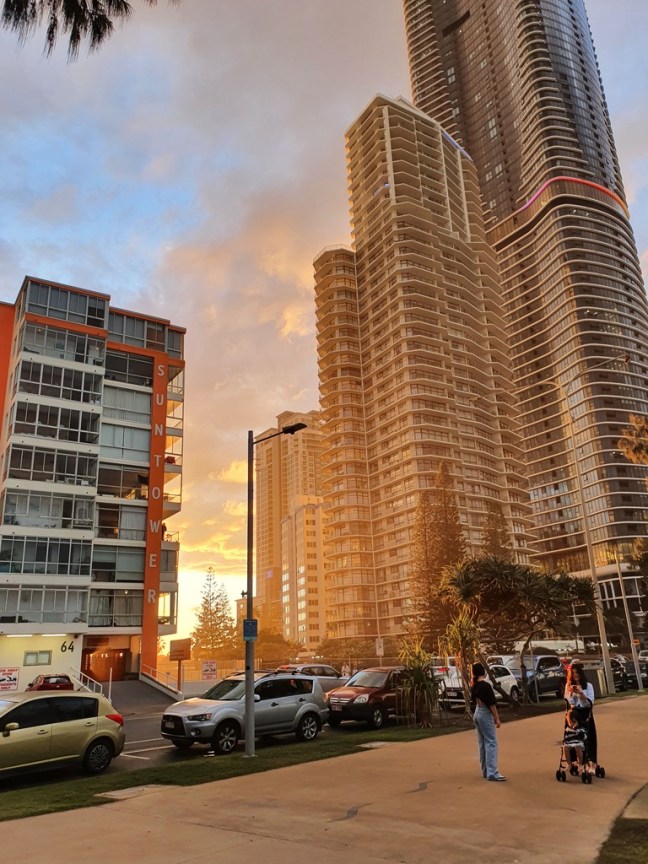
One thing leads to another in urban environments. In a series of feedback loops between what people want, say a beach lifestyle, and how this manifests physically, say the creation of waterfront real estate, the forces of change and emerging technologies intervolve and lay down a city’s building blocks. Surfers Paradise’s narrow streets, originally tracks to the beach carved out of rainforest a century and a bit ago, and grandly designated as avenues, boulevards, and a highway, are lined with tall buildings jostling for position and heaving with 20th Century machinery and technology.
Since its early days as a tourism Mecca, the city has relentlessly cleared site after site, and constructed, demolished and reconstructed buildings in wave after wave of redevelopment. Gold Coast’s first high-rise holiday apartment building, nine storey Kinkabool, made its appearance in Surfers Paradise in 1959. Over time, bigger buildings replaced weekenders and even bigger buildings replaced holiday apartments.
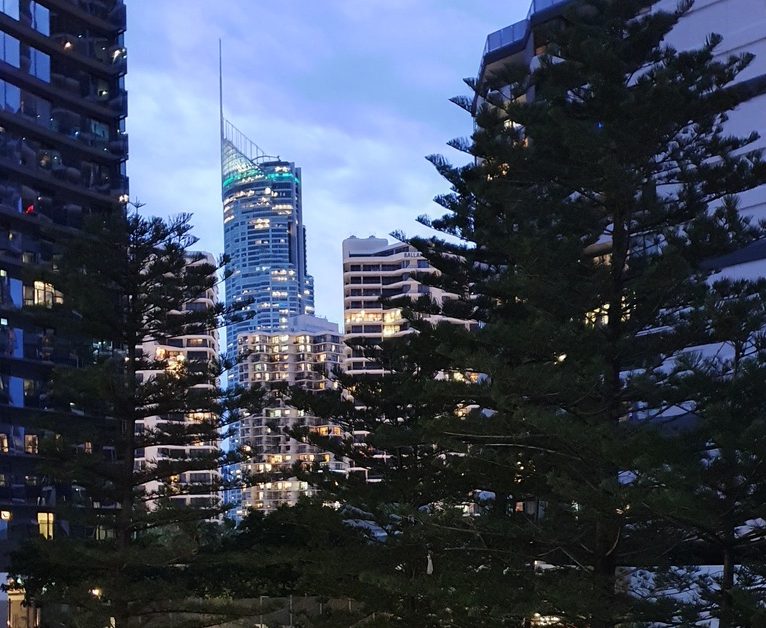
So-called ‘super-tall’ apartment buildings have been striking fetching poses on the Surfers Paradise skyline for nearly 50 years. The 34-storey Golden Gate opened in 1977. Thirty years later 78-storey Q1, the tallest residential building in the Southern Hemisphere at the time, was the harbinger of the giants.
Soul, Ocean and Ocean’s soon to be completed siblings with two mega-towers each, Iconica and the botanically-unlikely 92 storey pile Cypress Palms, are just the beginning. Taller and taller towers squeeze onto shrinking sites. These huge buildings are reliant on 20th Century technology that requires considerable expenditure of fossil-fuel energy and produces much unwanted noise (and heat) to move and store more people, more cars, and more garbage. In the high-density high-rise heart of the Gold Coast, noise has built upon noise inexorably.
These days, against the background roar of traffic and mechanical ventilation, the boom and thud of excavation, pile-driving, jack-hammering, drilling and pumping of demolition and construction jangle together. Buildings are ripped, torn, shredded and added to landfill and replaced by new stacks of concrete, metal and glass. Another luxury building boom is underway beneath an all-encompassing dome of noise.
Quiet on the inside
Air-conditioned bigger taller buildings are quiet on the inside. They need to be, because they are noisier on the outside. A 90 storey monolith needs a considerable amount of power and many banks of lifts to move a few humans up and down its incredible height. Its glass walls seal out the wind and noise. Without its air-conditioning machinery, booster pumps and exhaust fans it would be uninhabitable. Its engine room runs on diesel and gas.
If your neighbour is a colossus of this scale, its carpark is likely to be the greatest source of noise. Above or below ground level, car parks are full of toxic fumes that we deliberately put there! We bring carbon monoxide into buildings in our petrol-burning cars then use big noisy fans, jets, exhausts, and extractors, to get it out so we can breathe safely.
The maw of the carpark is also the gateway to the service area. This is the messy ‘back-of-house’ where the mundane necessities are organised for the building’s occupants. It is the Arrivals and Departures lounge for consumer goods destined for landfill. Deliveries of everything from furniture to food and beverage supplies; and collections of literally the same goods, discarded. Garbage in, garbage out. The noisy art of garbage collection? See my article ‘Urban Waste Management: A Noisy Dilemma’ and multiply to power of ten.
The carpark’s yawning entry still falls short for some vehicles. Too-tall delivery vans park on the entry ramp, their refrigeration units running non-stop during drop-offs that can take an hour or longer, while more idle in the queue. The merciless roar of compressors penetrates the consciousness of anyone within earshot to the exclusion of all other rational thought.
Removalists’ vans join in the procession. As households move in and move out of towers all over town, entire contents of hundreds of small apartments are in constant churn. Oversized vehicles reverse, beeping all the way across pedestrian footpaths and up or down ramps. It doesn’t always go to plan. Especially if the ramp curves as well as rises and the oversized truck gets stuck during manoeuvres. Where do design and good intentions go between the design drawings and the pouring of concrete? Perhaps the trucks got larger in the intervening years, trashing known ‘standards’ in their wake. Future ramps will probably be oversized as a result. Buildings’ street frontages are becoming all void and no front!
As for outsize cars, what is that all about? Multi-storey car parks are expensive to build and developers understandably want to make them as space-efficient as possible. Why would they want to make room for fewer, larger, cars, just because a few (relatively speaking) people bought the super sized car?
How big is too big?
High-density high-rise housing has been promoted by urban planners around the country for decades as the antidote to urban sprawl. Apartment towers of unlimited height are permitted by the planning code in Surfers Paradise and wholeheartedly embraced by developers with an appetite for risk. But let’s face it, per capita, multi-storey apartment towers have the highest greenhouse gas emissions of all housing types in Australia.
When it comes to building codes there is limited will by both the parties who are responsible for enacting the regulations and those who are bound to comply with them, to improve beyond the bare minimum ‘deemed-to-satisfy (DTS) solution’. By the way, the ‘DTS’ solutions are not mandatory; and are often neither the cheapest nor smartest ways to meet the ‘performance’ code which is mandatory. Achingly slow to change, out-dated codes still allow new buildings to be fitted with gas for heating water, pools and spas and for cooking despite all-electric alternatives being available.
Changes to the National Construction Code due to be adopted this year aim to “minimise future barriers to electrification should this be desired by a future building user”. It is unfathomable to me that the proponents of these most energy-intensive buildings are not doing their utmost to ensure they are set up for a sustainable future with power-conserving design and renewable energy solutions from Day One. Instead, they are happy to allow future occupants of the buildings under construction right now to be locked into expensive and dirty power by design, leaving owners corporations with potentially onerous technology retrofits to replace services that are significant users of gas like water heating and cooking, and other baked-in energy users, down the track. I think that’s one positive feedback loop residents would rather avoid.
Cleaner and quieter
We definitely know cars are getting larger, but in the long run, vehicles of all kinds will run cleaner and be quieter as well. People all over the country are switching to electric vehicles (EVs). While residents of existing apartment buildings are living in energy-intensive power liabilities with few options for charging EVs at home, it’s possible for households in detached homes and other types of smaller strata arrangements to reduce their home energy bills to almost nothing, and with their EV’s, their fuel bill is literally non-existent as well.
But precisely because house-owners have embraced rooftop solar and battery storage with gusto, strata apartment households may be able to share in some of the financial benefits of renewable energy that those occupying detached houses are enjoying. Across Australia, around one in four detached dwellings generate and store enough power to offset virtually all their electricity consumption, and share it to the grid during the day when generation is highest. Even without solar, it may be possible for strata owners corporations to store this excess renewable energy in batteries for later use.
New ways: new wares
Feedback loops that bring new needs and wants, also bring technical innovations for managing new issues that arise as the city gets taller and denser. In the next few years, EVs will be everywhere. And just like their friends in houses, residents of strata apartment buildings are looking for fair, affordable and safe ways of charging their vehicles where they live. Goes without saying that new buildings have to be EV ready. Good-bye and good riddance carbon monoxide.
Technical innovations are swiftly making simple what seemed complicated. Problems like metering, cabling, and access to power have all but evaporated with technological ‘fixes’ for modern charging systems that respond to residents’ actual needs rather than assuming that every EV requires fast charging.
It turns out that Australians’ driving habits mean that low-power slow charging at home is how most people charge their cars. Nationally, most people drive 33-36 km daily on average. In walkable Surfers Paradise, well-equipped with bike lanes, super-cheap buses and time-table free trams, it’s likely to be even less. Fast charging just isn’t needed in apartment buildings. Slow charging using standard power outlets is ideal for apartment buildings and can be achieved in existing buildings without expensive upgrades to the building’s power infrastructure.
Overcoming non-technical barriers to installing EV charging in strata buildings, stemming from lack of understanding and resistance to change, will probably prove more difficult. But not for long. Seeing nearly half Gold Coast’s population already lives in strata buildings, EV ownership in strata is inevitably on the rise. Residents of Surfers Paradise apartment buildings and their visitors won’t want to be left out of the widespread switch to EVs and will be instrumental in developing the governance solutions needed, and for achieving their preference to charge their car in their own parking spot.
Sight-lines are sound-lines
The behemoths are not the only buildings generating nuisance noise in the high-density city. Typical roof-top machinery like air handling units on office buildings and extractor fans wherever there are commercial kitchens, produces noise that travels unobstructed to anyone living in direct sight of them. In Surfers Paradise, that is almost everyone living above the second floor.
There is an office tower about 100 metres away from my place. High winds or a storm almost guarantee that something gets blown off kilter and the noise from its roof-top equipment will shift from an audible background chug to blasting like a maelstrom, roaring around the clock. A polite enquiry to the building manager about when relative respite might be restored, always gets the same response: “The part’s on order”. And yes, it must eventually show up, because in the overall cruddy soup of unwanted noise, that ingredient drops back to its normal constant drone after a few weeks. Maybe the time will come, fingers crossed, when the whole wonky unit will be replaced by a better, cleaner, quieter system.
Not a Fan Club
Commercial kitchen extractor fans rage well-above the background noise level but their high decibel tempests probably go unreported in Surfers Paradise. What would be the point? Only the residents of the few ancient buildings right in the heart of city that predate even the most outdated unserviced extractors are subjected to prolonged exposure to the angry roar. Everyone else closes their double-glazed doors and hopes for the best. It’s a complaints-based system but only the hopelessly optimistic would take on the work of actually lodging a complaint. So, no complaints. All is well.
We know nothing lasts forever. Either the ancient extractors will break down and be replaced by something slightly better, or, the buildings that house either the fan or the residents or both, will be replaced by something a lot bigger. Whichever is the sooner is difficult to predict but I have a feeling the buildings will go before the fans are replaced.
High profile change
Meanwhile one of Surfers Paradise’s most high profile colossuses – Q1 – is well on its way to reducing pollution of the noise, light and carbon emissions kinds.
According to their 2025 Sustainability Report, Q1’s building managers are incorporating energy efficiency and adopting emerging renewable energy technology with upgrades to its Building Management System and the high-speed lifts to its famous Observation Deck. They have replaced much of its lighting with LEDs and made smart changes to air conditioning thermostats in holiday rental apartments. Building gas usage has been reduced by up to 70% by replacing old gas burners with high efficiency heat pumps to heat the main lap pool and spa. Getting off gas and electrifying are not only saving considerable and costly energy, they are rewarding strata apartment owners in running costs savings as well. This is one Surfer Paradise giant quietly championing change and creating a better place for everyone.
One thing leads to another in the urban environment. Gold Coast prides itself on urban innovation. How good would it be if Surfers Paradise, world famous for lifestyle, took on noise at source and showed what transformation into a 100% electric city could sound like? And look like. World famous for amazing.