
Pollution is stopping me from opening the windows of my airy apartment at the Gold Coast. But it’s not the kind that requires an air filter. It’s noise. The street orchestra of garbage-wrangling ranks high as a repeat offender.
The noise we humans make is incredible. It’s also contributing directly and indirectly to that other pollution which is mostly invisible — CO2.
This is an article in the Surfers Paradise series ‘Tall Stories – Loud in the City’. By unraveling the complex tangle of noise in this small city of tall buildings, and finding out what could be done differently, perhaps we can find ways for residents of high density living everywhere to get fresh air and a better night’s sleep.
Thud! Crash! Tinkle…
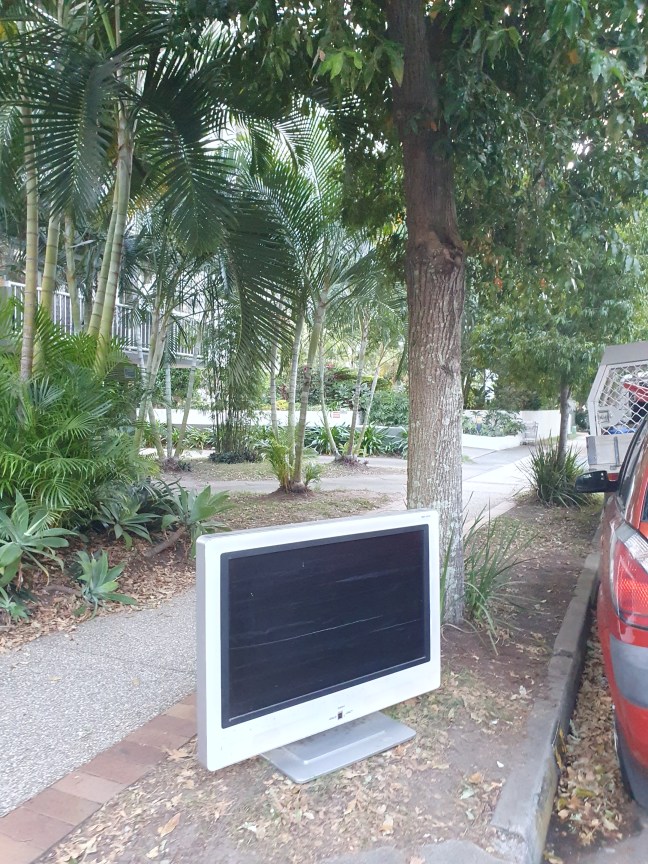
That’s the sound of something heavy-ish and fragile-ish landing in the skip bin in the driveway of a nearby apartment building in the early hours. Another day, another flatscreen TV is dumped somewhere in Surfers Paradise.
Is it because it has clapped out, its innards corroded by a hard life by the salty sea? Or was its demise the result of its early use-by date? Is it because the owner is moving on and can’t take the hunk of plastic and glass with them? Whatever the reason, out it goes with a bang. Out of sight, out of mind, somebody else’s problem.
SML/XL
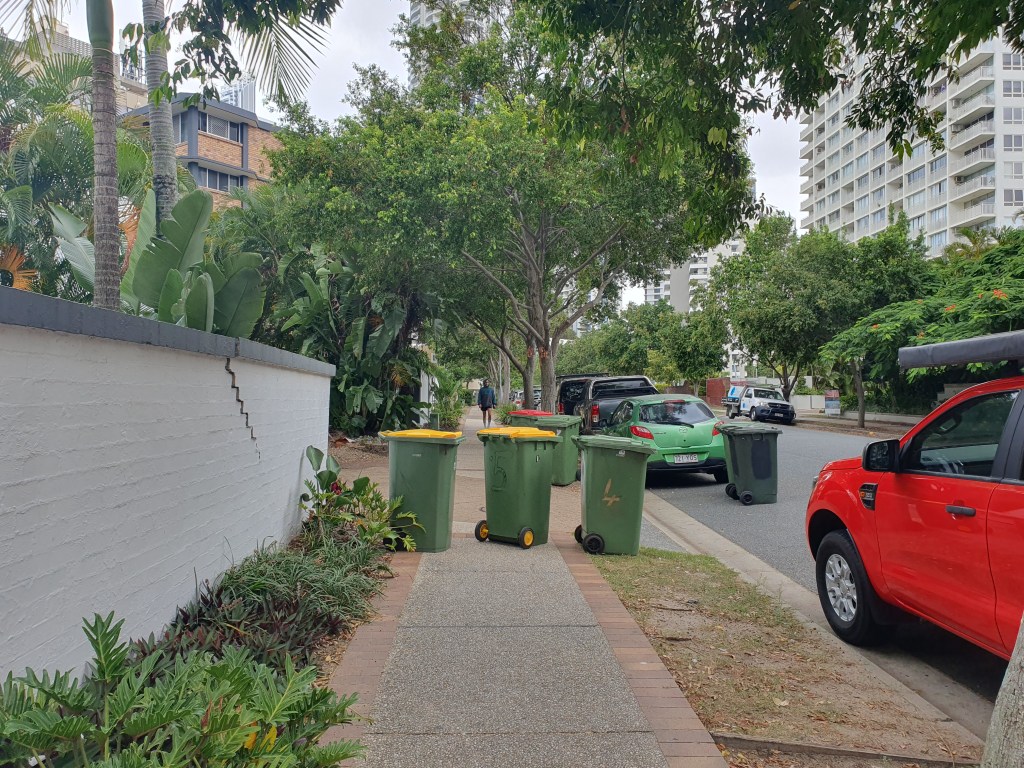
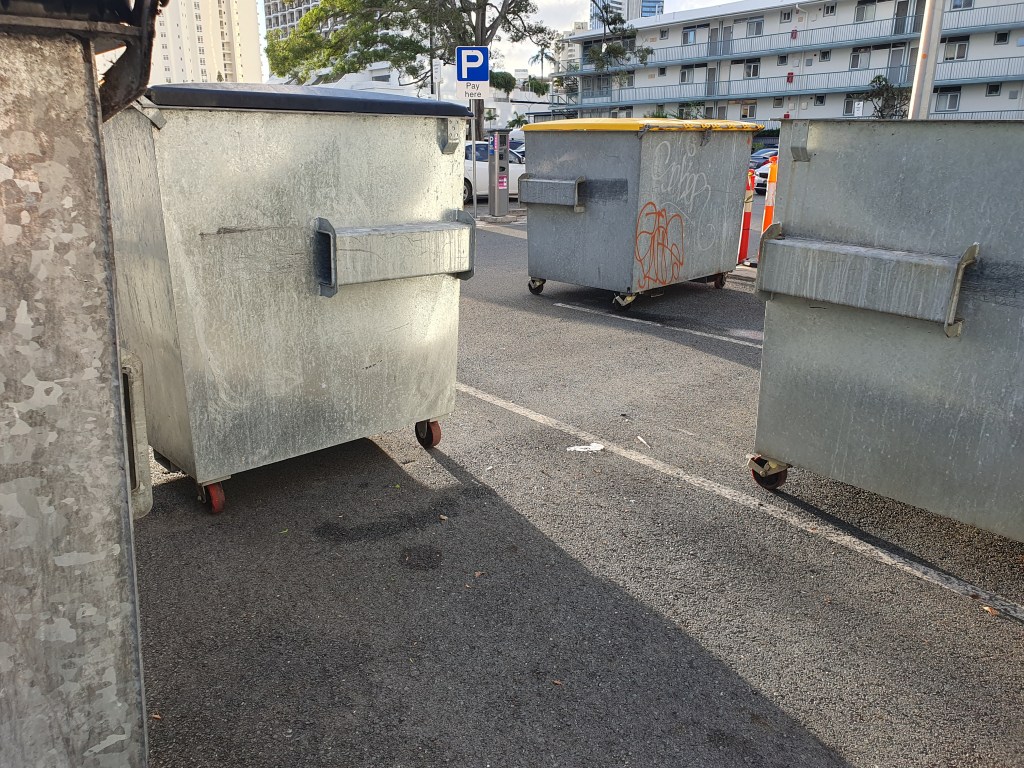
Every street in ‘Surfers’ is lined with an assortment of small, medium, large or extra large (SML/XL) buildings. The people who occupy them accumulate a lot of stuff. When they don’t want or need it any more, they discard this ‘domestic waste’ usually by collectively storing it in an array of SML/XL garbage bins corresponding to the size of the building. Lids in assorted colours designate receptacles for general waste, recycling and organic garden waste. Trucks come to drive it away, out of sight, out of mind, somebody else’s problem.
From pre-dawn, to well beyond breakfast and on into the late evening on any given day, the garbage collection schedule requires several visitations to each street by different trucks to cater for various combinations of building scale, bin size and waste type. A fleet of trucks, zooms along the avenues and through the cross streets like synchronised swimmers.
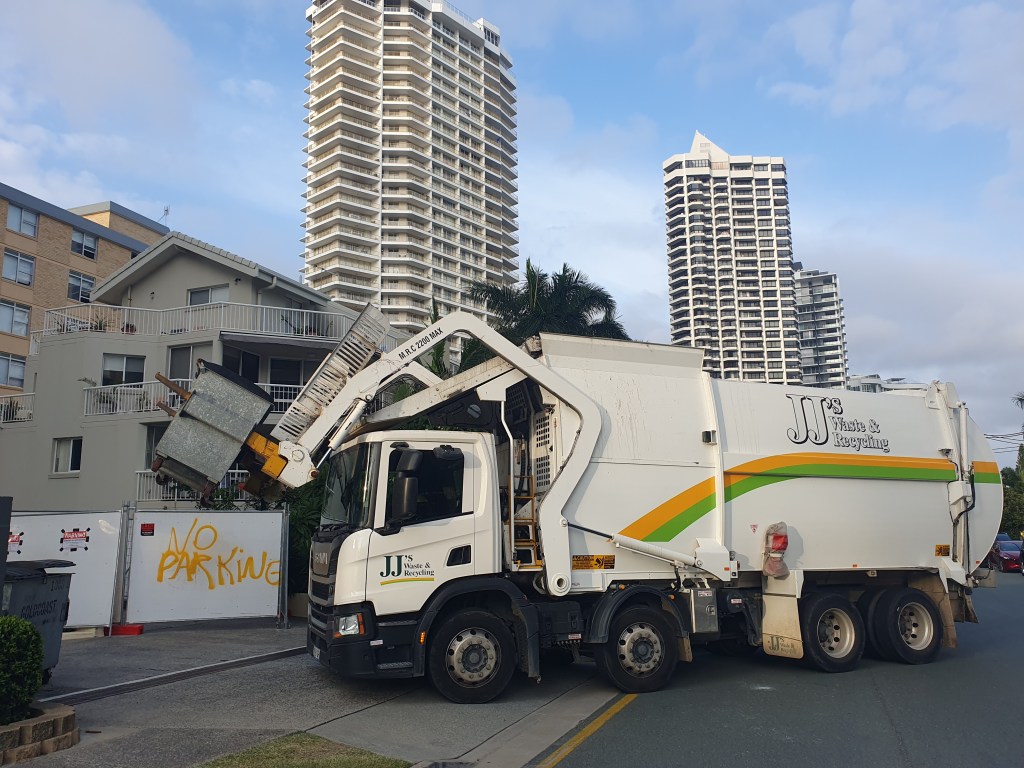
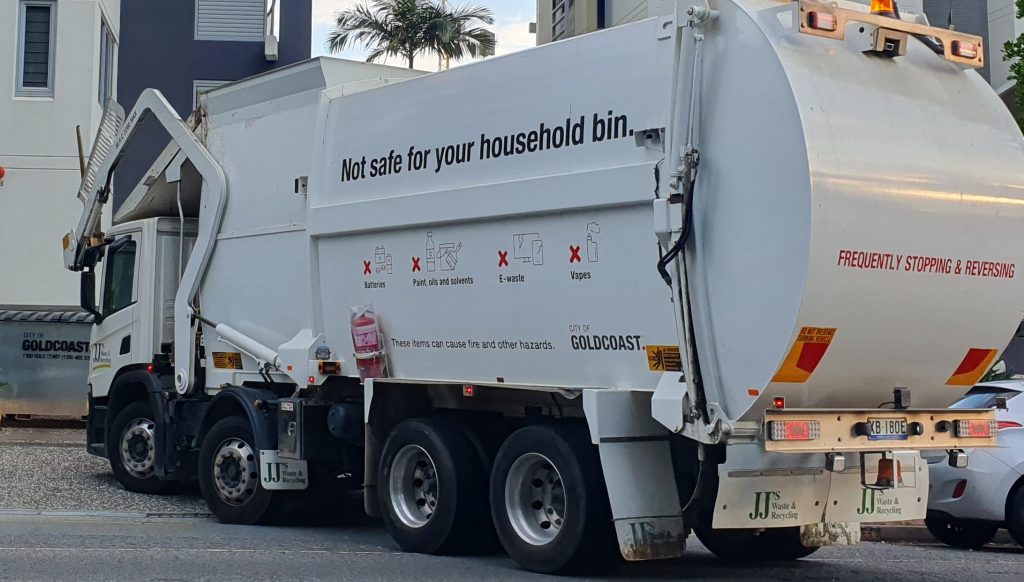
The process for one of these rounds goes like this. A garbage truck bearing the ironic corporate message ‘not safe for your household bin’ roars down the street to its assigned quarry, noses in to the driveway, grabs a bin with its giant clawed arms. Of course the message is meant to deter people from ditching dangerous stuff like vapes and dodgy e-bike batteries that might cause the load to catch fire. The truck reverses into the street far enough to lift the bin with its lever arms high overhead clear of tree or structure, all the while beeping or wheezily buzzing out warnings. With much creaking, clanking, and crunching of metal on metal, the bin’s contents pour into the bigger bin on the back of the truck, plonking emphatically. More clanking and gnashing, and the cruel metallic claws angle the empty bin back into position ready to slam it down to the pavement. A calamitous crash, further grinding of metal and the bin is released, surviving its encounter with the garbage collection truck once more. The truck then raspily manoeuvres about, toward the next target. Repeat.
The hullabaloo makes its rackety way around the neighbourhood, shattering dreams, silencing small talk and shouting down morning news reporters.
Because the rubbish receptacles are so gigantic, building managers are obliged to do their bit for the noise too. Commanders of tiny ride-on tractors that make a racket like combine harvesters (combine harvesters are probably far quieter) they swing into action to tow oversized, overstuffed bins out of basements into the approved collection positions the night before ‘bin’ day (which in some cases is every day). The next day, they tow the empty bins, now cavernous boom boxes, rumbling even more thunderously, back into their basement lairs. Inside apartments, conversations and ‘magic wands’ are defenceless against the din that sets up eight times a day eight days a week.
Cleanliness and maintenance
Of course, high-pressure hoses are needed to keep the big echoey bins clean. Mercifully, this isn’t a daily occurrence, but with every building in the local area factoring it into their cleanliness regime, this deafening driveway ritual can be counted on several times a month.
Highly house-proud Bodies Corporate love to clean their concrete driveways with high-pressure hoses too. Depending on the tarmac’s expanse, the transformation from dark grey to mid-grey can take a day to a week of a compressor running at full volume. Satisfying for some. Unbelievably noisy for those not joining in the fun of playing with water. And in between the full facial, the driveways must be kept clear of any stray leaves.
Your pet hate and mine
My immediate neighbourhood has a leafy green outlook. Some of the larger buildings have ‘tropical resort-style’ gardens and the streets that intersect near my place are lined with trees. Trees drop leaves. I’m still unsure why this is considered so offensive, but they must be dealt with! Leaves could simply blow away on their own, or, one person wielding a leaf blower for hours on end could achieve the same, and fray the nerves of hundreds of residents within earshot. Loud! No wonder they have to wear ear-muffs.
I want to yell: “Get a broom!!! It’s better for ya!” Of course they can’t hear me.
Edge-trimmers, hedge-trimmers, blowers, mowers, chainsaws — the industry of garden maintenance in a strata-titled community is diesel-driven. Electric gardening equipment is far more socially acceptable and has been used by our building caretaker for years. The noise is barely noticeable. The maintenance crew with the contracts for two of the largest buildings nearby has just switched to electric battery-driven equipment. Things are looking up. Now we only need to work on the other seventeen hundred and ninety-eight properties to have them change their equipment from diesel to battery power Fallen palm fronds are a different matter. They can’t be blown away, and are not great in land fill. They take something like 30 years to break down. Palm groves are so ubiquitous here – some gardens consist entirely of palms – so in comes the industrial scale wood chipper. The serrated noise of maceration fills the day. Branches and anything that was once vegetation is munched, then driven away. Out of sight, out of mind.
Time to get an electric mulcher. Would tree mulching even be necessary if, instead of exotic palms, Surfers’ endemic coastal rainforest species were grown in gardens? It’s time to review what we grow in our gardens and streets.
Lately, developers seem to be doing away with street level gardens altogether, selling the deeply flawed argument apartment owners would no longer need to ‘waste’ money on grounds maintenance if they had a roof top garden instead. Wrong. Instead of limiting space for gardens and real plants that contribute to neighbourhood quality, developers should be applying their creativity to questioning and redressing how ‘waste management’ requirements affect both their development yield and owners’ corporations’ budgets.
Managing waste is expensive
Every time a new apartment building or the like is designed and constructed, developers are obliged to foot the bill to build things like bin chutes, bin rooms and turning areas and ramps and driveways for waste collection vehicles. From the point of view of saleable floor area, ‘managing’ waste is a waste of space. Public surroundings suffer as well. Moving mess takes precedence over pedestrian amenity. Instead of delightfully shady green streets to walk along, large swathes of streetscape are given over to driveways and great gaping blank portals. The larger the building the greater the gaps and dents that facilitating the waste management regime make.
Somehow the whole cacophonous choreography of waste ‘management’ has become the accepted system here. It’s a similar situation in other Australian cities.
What are the alternatives?
Amsterdam, with a much denser population than Australia’s urban centres, manages it, not soundlessly, but not in this overblown SML/XL system. In a city where space is at a premium, over-scaled receptacles are unthinkable. There, householders take out their household garbage to a normal-looking street bin, usually as they leave the house and go about their normal day. The bin is all you see but it conceals a larger underground collection well. A single collector truck comes along, lifts and empties the whole unit, and leaves. Noise done, once daily.
I’m guessing that Amsterdammers might generate less waste per capita than we do with our bottomless bins. Overall, smaller bins mean less waste as people think twice about what they discard. And less junk is likely to be dumped when there are ‘eyes on the street’. The bin doesn’t open wide enough to take large objects like prematurely defunct home appliances or broken furniture. If you decide to try to stuff your old microwave oven into the bin and instead leave it for someone else to deal with, everyone knows. But there are collection points for bulky items too.
Imagine that system happening here! Just like Amsterdam, in terms of proximity and topography, central Surfers Paradise is a walkable place. But its streets lack decent public footpaths and it has limited space underground for containers like this. However, if you think about ‘bin day’ when our footpaths are lined with plastic wheelie bins and every other day when the streets and pathways are cluttered with the giant metal hoppers, something like the unobtrusive ‘stealth’ Amsterdam bin becomes a far more attractive alternative.
On the other hand, Taipei has no bins on the street at all. Despite every convenience purchase of fast food coming with a hefty side of unwanted stuff like soft plastic packaging, and extra scraps of paper, you’re obliged to take your rubbish home with you. The city removed thousands of public bins over a decade ago when the place was swimming in trash and landfill sites overflowing. This is to ensure that residents can’t avoid waste management fees by skipping out to the public bin with private waste. Municipal collection comes round daily and people meet the vehicle with their household trash sorted into plastics and non-recyclables; no big bins are dragged out to the street. Householders pay to dispose of anything that can’t be recycled, such as soft plastics which are destined for incineration by waste management contractors. One thing that is avoided is the noise of manoeuvring and emptying big bins around the neighbourhoods.
Amsterdam and Taipei are two of the world’s best recyclers of plastics. In a few years from now, by 2030, simply by reusing materials instead of trashing perfectly useful resources, Amsterdam will halve the volume of raw materials it consumes in constructing and repairing buildings and roads, manufacturing electronics and producing food annually. It aims to become the world’s first Circular Economy city by 2050. Nothing will go to landfill.
Taipei is a top waste recovery performer in Asia. But the similarities with Amsterdam end there. According to Beina Xu (Deutsche Well 2025, no bins in Taiwan? You Tube http://www.youtube.com/watch?v=-YnYWiSiuE) Taipei imports plastic waste for processing because its recycling industry is larger than its domestic supply. It seems there is no real plan to reduce actual waste apart from behaviour change using the stick rather than carrots.
Why not small-scale solutions to control how much stuff actually leaves a site and goes to landfill here at the Gold Coast? Here, people take the massive bins as a licence to dump their unlimited junk, out of sight out of mind. Limiting what people can chuck away by downsizing our huge bins could lead to behaviour change here too. After all, we had far less garbage when we had small bins. We also had access to far less consumable junk then.
The City of Gold Coast is planning to divert the huge load we currently send to landfill through the proposed Advanced Resource Recovery Centre (ARRC). But it’s unlikely that the existing involved system for accumulating and storing our garbage in huge metallic bins to be taken away in trucks carrying bigger bins will change. The ARRC’s business model will still need the whole ‘discard-as-much-as-you-like-and-we’ll-take-it-away’ system to continue indefinitely. If the current concept of ‘waste’ persists, unwanted noise will still blight the night and day.
Whose responsibility is it anyway?
Should ‘waste’ even be a municipal responsibility? What if the paradigm that has local governments managing ‘waste’ and we ratepayers paying for it in more ways than sleepless nights, were to shift?
What if we simply refuse to pay for this anymore and instruct our elected leaders to put the onus on the parties who produce the waste to take responsibility for managing it? Jonathan Baker from Adelaide University points out how the plastics industry has rigged the system for decades. He wrote in The Conversation, “For 70 years the packaging industry has led advertising and lobbying campaigns that trained us to see waste as our individual failing and a municipal responsibility.” It is neither. It is a “design flaw in the market system itself.”
I can’t stand to see plastic bottles and other packaging and remnants of manufactured junk in or near the ocean. Every time I pick up plastic left behind on the beach or washed up on the high tide, I’m being used by the packaging industry to do their dirty work. Devilishly clever marketing by corporations uses our good intentions against us. While we ‘Do the Right Thing’, they don’t change their ways; they just find new ways to package it and keep churning out more unnecessary un-recyclable un-reuseable stuff that people acquire and quickly discard. They keep on making profits at the expense of the environment we all live in and depend upon.
Hello circular economy
Imagine the stink the producers will kick up when they are made by law to fund the cost of managing waste? Once they get over the shock, suddenly garbage collection and garbage processing infrastructure will be far less costly because these entrepreneurial geniuses will find ways to produce far less gratuitous packaging and far less unwanted stuff to be processed, and far better ways of keeping it in the supply chain instead of in our oceans, creeks and landfill. Hello circular economy. The number and type of trucks doing the loud choreographed routine around the neighbourhood would decrease remarkably. As an added bonus, the streets would be free of unwanted bins and driveway clutter and generally become more pleasant and engaging for walking and cycling.
Reassigning responsibility and remaking the waste system will take time but is not beyond the realms of possibility. ‘Waste’ as a concept is slowly evolving. Plastic drinking straws have been banned and single use plastic shopping bags have kind of disappeared (not really). We adapted and moved on; behaviours around straws and shopping bags changed.
But what will make a difference to urban noise in the process?
Gold Coasters are legendary early risers, and not having to share the early morning with the garbage brigade would make a great start to the day even better. But until we engage with our garbage instead of pouring it into the mythical bottomless pit of the metallic hopper, locals, holiday makers and shift-workers who might like to sleep in past dawn will continue to be rudely awoken by that crashing 5.00am wake-up call of the metallic trash slam. Bring on the waste-not revolution. Out of sight, out of mind, out of earshot.

 subtropicalcities.com