

Here at the Gold Coast, one weather system after another has dramatically re-shaped the famous shoreline since TC Alfred first made its presence felt off the Queensland coast in late February.
TC Alfred. The name could come from a time when we addressed people more formally and respectfully. It could belong to someone like a poet or perhaps a philanthropist, or a long gone prime minister. TC Alfred definitely deserved respect. It was a tropical cyclone that was drawn inexorably into overheating subtropical waters. Instead, we laughed it off as a Category 1 cyclone, so ‘weak’ that it degenerated on landfall and became known as Ex-TC. But our lack of respect was repaid in full. Ex-TC Alfred swotted communities across Queensland with its powerful back-hand, leaving inundated communities and wreckage in its wake.
During the summer of 2021-2022 when I first lived in an apartment on the edge of the Pacific, the experience was unexpectedly intense1. As the Gold Coast started to shake off the COVID19 border closures, it seemed as if La Niña was intent on throwing almost everything at us to keep us cowering indoors.
Torrents of rain, detritus-laden floodwater and mountainous dark brown waves gouged the beaches. At Narrowneck, the boulders of the seawall built decades ago were exposed at the base of a nine-metre high sheer sand cliff. A hopeful log-and-wire fence clung to the precipice. Otherwise, beach erosion was barely noticeable to my untrained eye. Though the beaches had little ‘free-board’ especially at high tide, the dunes were broad and intact under a protective layer of coastal vegetation.
Nevertheless, it took a year or probably two, but heavy machinery and ingenious ways of moving sand around eventually built the beach into a wide expanse far faster than the natural process of the longshore northward drift of sand would have. Locals and visitors reveled in the sheer vastness of the open space — room for everyone on the perfect beach.
Just three years after those storms, the open beaches from The Spit to Rainbow Bay are again undergoing large scale sand loss in a process that began while TC Alfred was still hundreds of kilometres out to sea.
By late April, wind-driven ocean swells and high tides were still joining forces to bite and swallow tonnes and tonnes of beach sand from that slender strip of reclaimed land standing between the high-rise towers and the Pacific Ocean. The vegetation holding the banks together, painstakingly coaxed over the past few decades, all but disappeared, leaving steep escarpments and no beach to speak of. The big Easter crowds pressed together on the Esplanade and the Oceanway path at Surfers Paradise.
World leading coastal protection
Over past months, we’ve heard often that Gold Coast is a world leader in coastal protection and management. For good reason. The resort city pins its entire identity upon the perfect beach. Day-by-day, coastal engineers pit themselves against the awesome might of the Pacific Ocean. The imperative: to shore up the billion dollar image that tourists love.
Coastal hazards and destructive swells be damned. Sand trucks doggedly dump more sand up against the scarp which seems to move further landward with every new high tide. A huge Danish-owned dredger has been brought into service to speed up the process of moving the sand dragged out to sea back in-shore2. The Council’s efforts to protect the constructed seawall are herculean. Yet as time goes on, more and more of the A-Line is exposed. The A-Line is the acknowledged ‘last line of defence’ of the infrastructure of the Esplanade and private property. It lies beneath dunes that are largely man-made piles of sand.
Prior to this current cataclysm, the Gold Coast’s beaches were far from pristine. Not only have storms often lashed the coast and altered its profile, the beaches have undergone episodes of deliberate environmental degradation since Europeans began exploiting them.
Ironically, machinery like the bulldozers and dredges that are now in service to replenish the beaches once excavated them for minerals. From 1928 until the 1980s, sand miners cleared coastal vegetation and ‘tore up all the Gold Coast beaches’ (Byrne and Houston p253). The subtropical littoral rainforest disappeared. Who would know now? The coast appears to have absorbed the effects. But image isn’t everything.
The perfect beach is more than a skin-deep ideal
The local authority has become far more aware of the role of coastal vegetation and stable coastal dunes. These days, beach reconstruction is high priority. The wide beach is actually a serious coastal management strategy to protect the dunes that conceal the A-Line. The very same urban development that has been the primary source of environmental damage over the past six or seven decades, now relies on the beach being an effective buffer zone between the ocean and the boulder seawall, for its existence.
The success of the perfect beach strategy has made the beachfront even more attractive. A home beside the beach is more sought-after than ever. Property development is booming in vulnerable locations like the Surfers Paradise and Main Beach foreshores. On one side of the A-line, the city is working hard to shore up the perfect beach. On the other, the excavators are digging out basements, and pouring concrete like there is no tomorrow as tower after tower jostles for front row position.
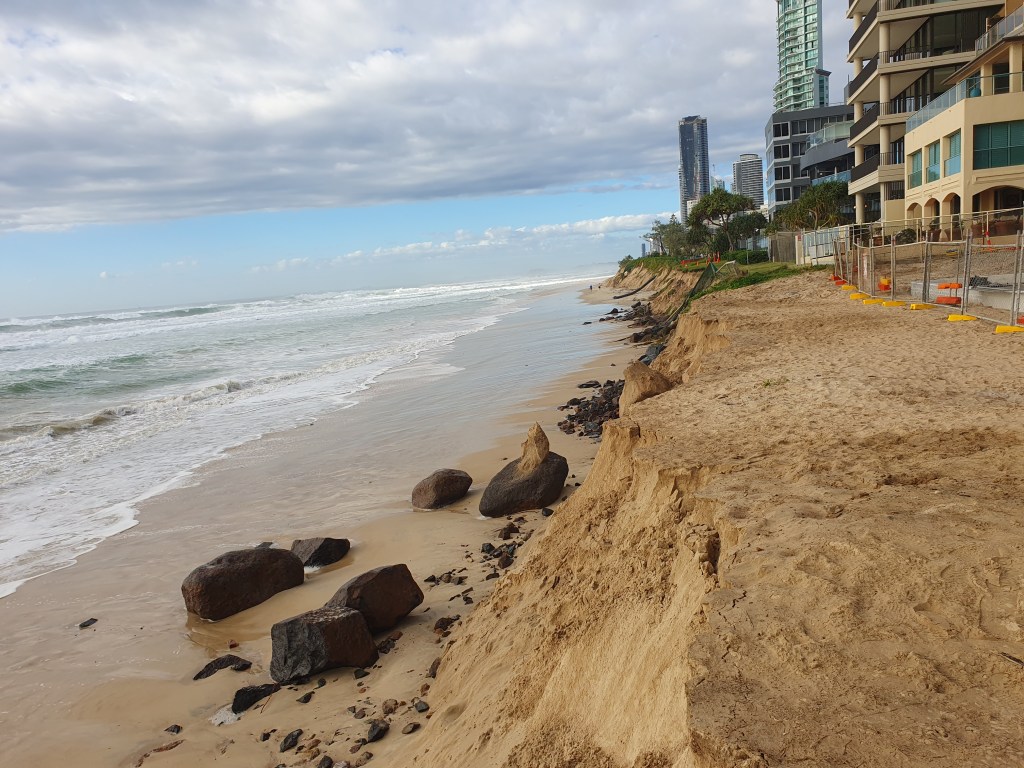
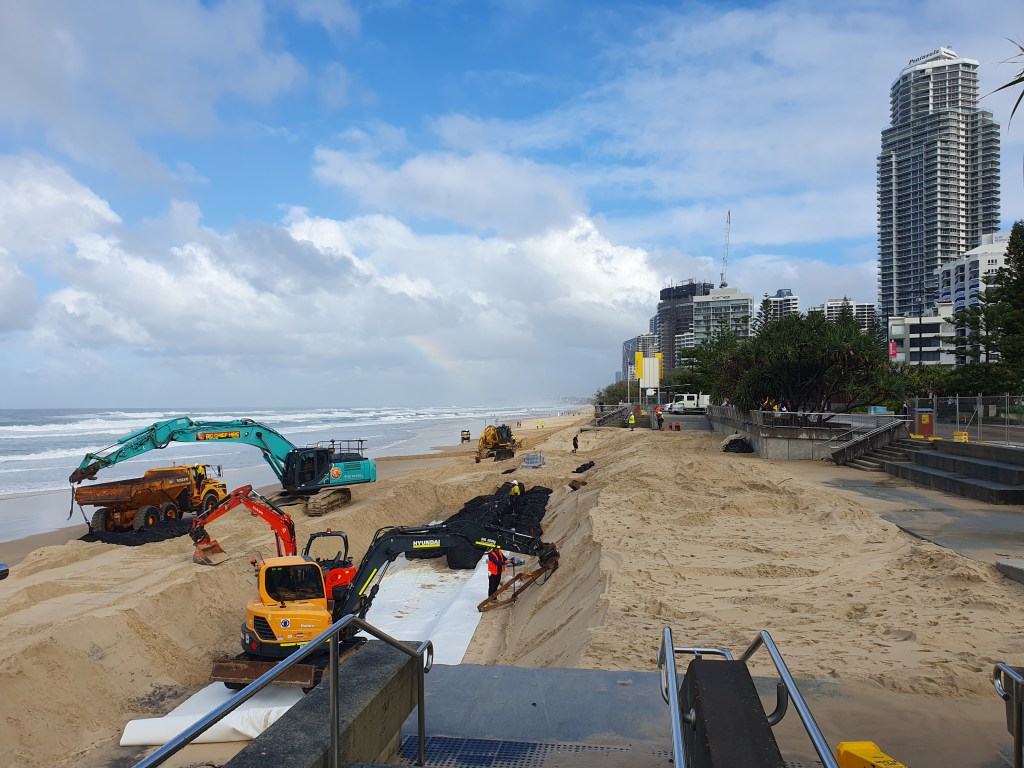

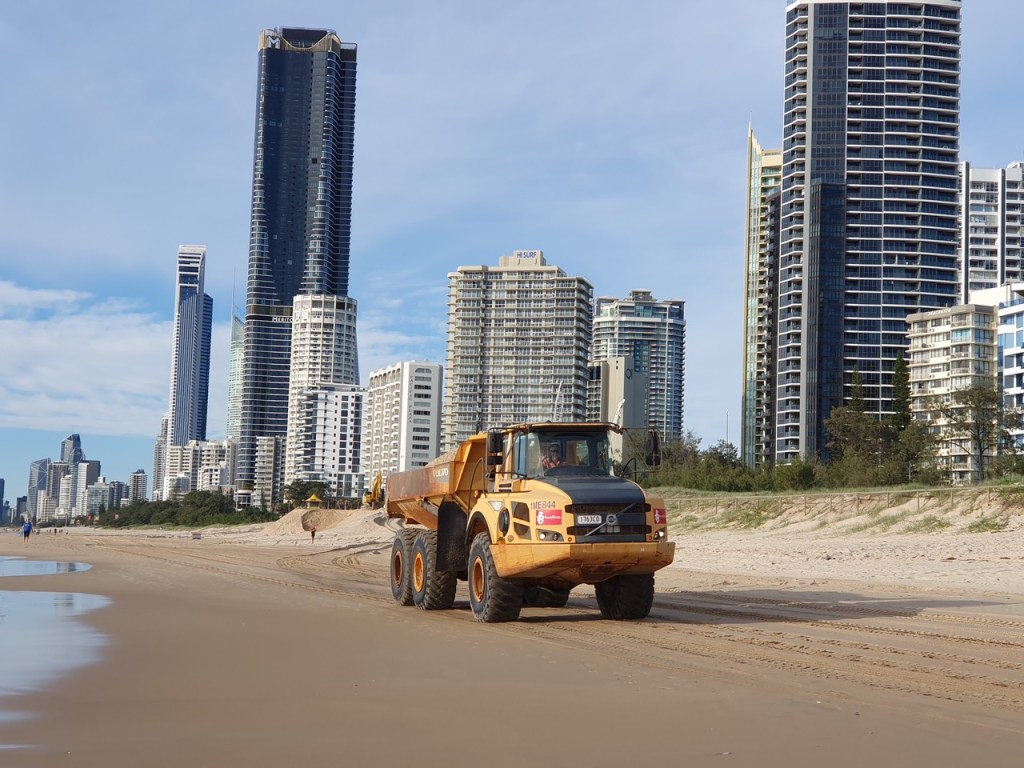
Rather than limiting the potential for more built assets to take shape in harm’s way, the city is locked into costly ‘interventions’ to manage the risk to both public and private property (Byrne and Houston, p293). As well as rock groynes, boulder walls and ‘super banks’, the city installed a sand back-pass pipeline from the Spit to Surfers Paradise. Continuously maintaining or restoring the integrity of these interventions is expensive and unrelenting. The more we do, the more we must do. Counting the current operation, the specialised off-shore hopper dredges have worked on the coast for at least three extended periods in the past eight years4.
Storms and sand erosion are part of a natural cycle where beaches contract and gradually reform as sand returns to shore. But as global climate change intensifies, events like TC Alfred are predicted to increase in frequency and intensity. Resilience, the buzzword of the decade, describes the speed with which something or someone or a community returns to its former state after it has been perturbed and displaced from that state. Is the time coming when the periods between recovery and perturbation of Gold Coast’s famous beaches become shorter and shorter? How much is reasonable to ask ratepayers, or even tourists, to spend on the perfect beach? How much is too much? TC Alfred was a harbinger of future storms. The next TC might be even stronger and bring impacts we can barely contemplate.
Beach restoration using the engineering approach perpetuates the image of the perfect Australian beach in the perfect environment. But under natural circumstances, the image is a myth. Perhaps it’s time to start adjusting locals’ and visitors’ expectations of what makes the perfect beach? How long can we afford to shore up the image? All the while, sea levels around the world are rising. At some stage, the engineering solution will fail. Inevitably5.
References and notes
- 1 Kennedy, R (2023) This (Flowing) Life. Weekend Australian Review. June 10-11, p.27
- 2 City of Gold Coast (2025) Sand pumping works to begin. https://www.goldcoast.qld.gov.au/Council/City-news/Sand-dredge
- 3 Byrne, J and Houston, D (2016) All that glitters: an environmental history ‘sketch’ of Gold Coast City. In Off the Plan, The Urbanisation of the Gold Coast. (Eds C Bosman, A Dedekorkut-Howes, A Leach). pp. 17-29. CSIRO Publishing, Clayton South, Victoria.
- 4 McElroy, N (2017) Mayor calls in Danish barge to “rainbow” tonnes of sand off Gold Coast Beaches. Gold Coast Bulletin. June 15.
- 5 For example: Failure of beach replenishment and other attempts to hold back the sea on Long Beach Island, New Jersey during Hurricane Sandy 2012; Failure of levees and flood walls in New Orleans during Hurricane Katrina 2005.
 subtropicalcities.com